
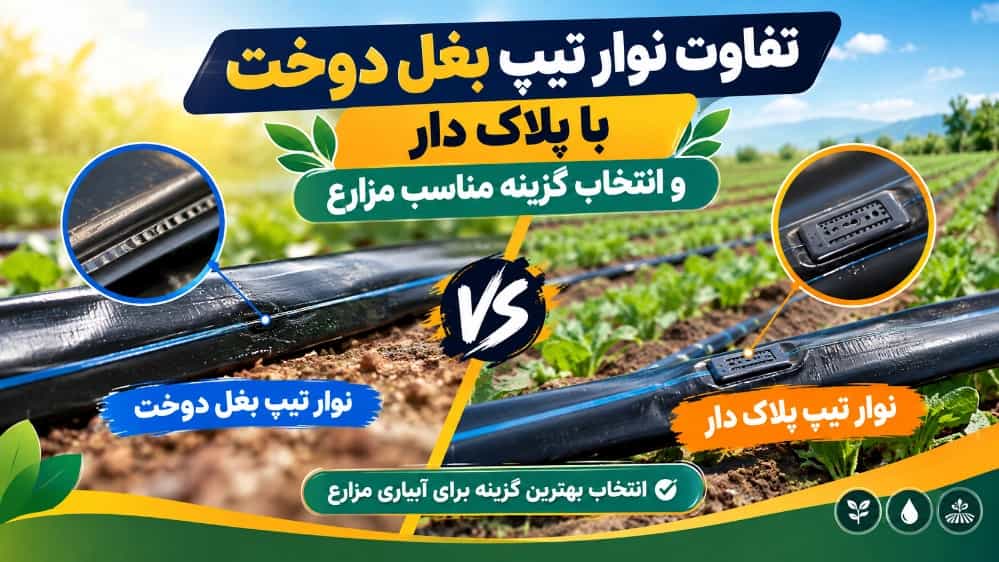
New drip irrigation has found a decisive role in the agricultural sector of the country due to the serious limitations of water resources and the need to increase productivity. Farmers, horticulturists, and implementers of intensive cropping schemes spend significant amounts annually on water management. One of the most key equipments used in strip drip irrigation is tip tape. Today, two common models are available in the market, including the sewing side tape and the plate type tape, each of which has its own technical characteristics, strengths, and performance limitations. The wrong choice between these two tools will not only waste the initial capital, but will also lead to uneven crop growth, increase in fuel and pumping costs, and incur extensive financial losses.
Knowing the structure, advantages, disadvantages and hydraulic behavior of each type of tape is the basis of designing precise water supply systems. Lisa Pipe Company, as one of the pioneers in the production and distribution of irrigation equipment and polyethylene pipes, always emphasizes the principle that optimizing water consumption and improving harvest tonnage goes through the path of specialized knowledge and the use of standard tools. In this comprehensive article, the difference between the side-stitched type tape and the one with a plate is examined from various angles so that every farmer and water engineer can choose the best irrigation system according to the type of product, the topography of the land and the quality of the incoming water.
Knowing the band of the sewing band and its technical specifications
Sewing armband, which is known in market literature as seamed or armband, is produced by forming polymer sheets of light and high-quality polyethylene. In the production process of this product, the edges of the tape are placed along each other and connected to each other with the help of heat and ultrasonic welding technology or continuous thermal stitching. The result of this process is the creation of a zigzag path or a continuous turbulent flow path at the edge of the strip, which is called a zipper or spiral path of pressure reduction. Water enters these narrow spiral channels from the main body of the pipe, and after the controlled pressure drop, it leaves the outer pores in the form of regular drops.
The sewing side band does not have any hard or separate plastic parts inside the body, and the whole tube is made of a single material. This problem reduces the weight of the coil, enables denser packaging and a faster production process. The zigzag construction of the side seam tape is somewhat susceptible to clogging by very coarse particles, but when provided with standard filtration, it offers tremendous flexibility in installation, transportation, and collection from leveled surfaces.
The Lisa Pipe collection sells all kinds of sewing tapes using first-class petrochemical raw materials and stabilizing pigments against the sun's ultraviolet rays, so that farmers do not have to worry about bursting, tearing seams, or rotting under strong sunlight during the growing season of summer crops, cucumbers, tomatoes, watermelons, and corn.
A comprehensive introduction to the tape type with a plate and the mechanism of operation
Plaque type tape is a more modern category of thin tape tubing that incorporates engineered droppers and pre-formed, spaced hard plastic parts into the tube structure. These drippers, which are called "plates" or thin linear drippers, are attached to the inner wall during extrusion and forming the polymer tube. Each plate has inlet channels equipped with a dedicated micron filter, turbulent flow channels to break the water pressure and a water outlet chamber.
The distinctive feature of the type tape with a plate is the ability to adjust the output flow rate more precisely. When the water enters the internal chamber of the plaque, it first passes through the toothed filters of the plaque itself and then passes through the winding paths and creates the required pressure drop so that the water is discharged with a completely uniform flow along the long cultivation lines. Unlike the seamed models, the body of the plate type tape does not have any stitching or longitudinal welding line and is completely integrated, seamless and circularly produced. This structural feature significantly improves the tape's resistance to sudden changes in water pressure inside the pipe.
Lisa Pipe has made it possible for the designers of drip irrigation systems to implement the best possible efficiency for intensive greenhouse crops and modern gardens by supplying the plate tip tape in standard outlet distances such as 10, 20 and 30 cm and with different flow rates based on liters per hour.
Fundamental structural differences and water discharge mechanism
The major differences between the sewing side type band and the one with the plate come from the way of production and the geometric structure of the water outlets. In side-stitched tape, the spiral grooves are part of the pressed layer of the tape edge as a flow path. For this reason, minor changes in temperature and tape elongation during spreading may cause subtle changes in the geometry of these sewn channels. However, in the plate-type tape, the plate piece is made of molded plastic injection and is very strong, and the passage of the tractor or the stretching of the tape does not change the shape of its spiral layers.
In terms of the continuity of the wall, the absence of a seam in the plate type strip makes these pipes better able to withstand impact pressures or phenomena such as weak ram impact. On the other hand, the sewing side tape requires more precision in the system input pressure to prevent the seams from breaking or asymmetric swelling. The specialized products produced by Lisa Pipe, by applying precise production tolerances, bring the stability of the seam connections in the sewing side models closer to the national standard, and in the models with plaques, they ensure the definitive adhesion of the plaque to the inner layer.
Comparison of sensitivity to clogging, filtration and water solutions
The quality of water used in agricultural fields is the most decisive variable in choosing the right irrigation strip. Many underground water tables in the country have heavy salts, salt and sand particles.
Due to the structure of the spiral seam without an independent inlet filter, the tape of the sewing type is more sensitive to fine mud and biological deposits caused by algae. If the farm filtration station does not have the desired quality, suspended particles are easily trapped at the end of the twists and turns of the seam of the side seam, and its output flow decreases over time.
The tape type with plaques shows better resistance against the entry of impurities due to having micron input filters in the opening of each plaque. In addition, if chemical clogging occurs due to the deposition of calcium carbonate or sulfur, the turbulent flow path in plaques is better cleaned due to the deeper geometric profile, and the possibility of injecting permitted agricultural acids to de-sediment has a higher reliability factor. The technical experts of Lisa Pipe strongly recommend that even with the use of the plate type tape, the farmers should not neglect to equip the water source with a disk or mesh filter of at least 120 mesh so that the useful life of the irrigation lines continues for several seasons.
Evaluation of spraying uniformity and hydraulic behavior in uneven lands
On the other hand, side seam tape along long pipes may suffer more water loss at the end of the line. Therefore, the length of the allowed row for the band of the side sewing type is determined to be shorter than the one with the plate. Also, in lands with a gentle slope and uneven lands, the plate type tape shows better stability in maintaining pressure, while in the sewing side type tape, any change in the slope of the land can intensify the pressure drop and lead to an imbalance in the drip. The use of Lisa Pipe engineered strips allows designers to calculate and implement the maximum lateral length with high confidence.
Economic comparison, initial cost and functional durability
Farmer's budget is an integral element in deciding to choose a band. In terms of price and initial cost, sewing arm band is cheaper due to the simplicity of the mechanism and the lack of injection droppers. For farmers who grow seasonal crops with a short growing period of three to four months, such as lettuce, vegetables, carrots, or eggplants, the production of sewing tape is a cost-effective and economical option. The quick return of investment in this type of farms makes the buyer not willing to pay extra for the license plate.
The plate type tape has a higher initial purchase cost compared to the stitched type tape, but due to its higher durability, extraordinary tensile strength and accurate life span comparison, it is a strategic choice for fields with successive cultivation and products such as cotton, sugar beet and industrial tomatoes. The functional stability of the plaque strip minimizes crop losses due to local dehydration, which fully justifies the initial price difference in the macro-scales of cultivation and industries. Lisa Pipe has facilitated farmers' access to both product groups with the best price-to-quality ratio by creating appropriate pricing and guaranteeing the quality of consumables.
How to install, run and collect from the fields
The stages of establishing irrigation strips in the field are directly related to their physical structure. Due to its lighter weight and high flexibility, the sewing arm band makes the spreading operation with the help of mechanized tractor trailing tools very easy. However, it should be noted that the stitched edge of the tape should always be facing up to prevent the seams from scratching on stony soils and the irregular outflow of drops. Also, when the tape is stretched on the ground, the tension should be applied evenly so that the thermal zippers are not subjected to transverse pressure.
Which tape type is suitable for which farm?
Choosing between the side stitch type tape and the plate type tape requires the analysis of four main components, including the topography of the land, water conditions, type of plant and time horizon of cultivation:
If your farm is low and high and sloping, the length of the planting lines is considered long, the water quality is average and with salts, or your product requires uniform water management in a longer cycle, the plaque type tape will be the best possible choice for you. This model guarantees flow stability and reduction of secondary costs.
If your agricultural land is completely leveled and lasered, the cultivation lines are less than eighty meters long, you have a clear water source with precise filtration, and your product is a short-term seasonal crop or a rental where economic efficiency and minimizing the initial cost play a decisive role, the side seam tape will bring the best efficiency in terms of cost.
Lisa Pipe specialized center is ready to calculate the pressure drop and allowed branch length by receiving detailed information on cultivation and the characteristics of your agricultural lands and suggest the best option according to the climate and soil conditions.
Why buying tape from Lisa Pipe guarantees your profitability?
Purchasing directly from Lisa Pipe brings the advantage to the farmer that unnecessary middlemen are removed and irrigation equipment is delivered at factory price and in standard size. Our experts consider ensuring the quality, health of connections and output without fluctuation as the primary principle of their commitment and help the country's farms on the way to overcome drought and achieve sustainable profitability.
summary
The difference between the sewing side type tape and the plate one is more than an appearance change in the body of the tube; This difference has a direct effect on water consumption efficiency, farm irrigation management, crop yield and project economics. With its integrated structure, lightness and competitive price, the sewing sideband is an economic answer to flat fields and short-term summer crops. On the other hand, the plate type tape with engineered drippers, superior resistance to clogging and unparalleled watering uniformity is a good investment for strategic crops, long lines and uneven land. Lisa Pipe Company, as a reliable partner of the agricultural sector, has provided access to both products with the highest quality standards so that farmers can take an effective step in saving vital water resources with full tact.