
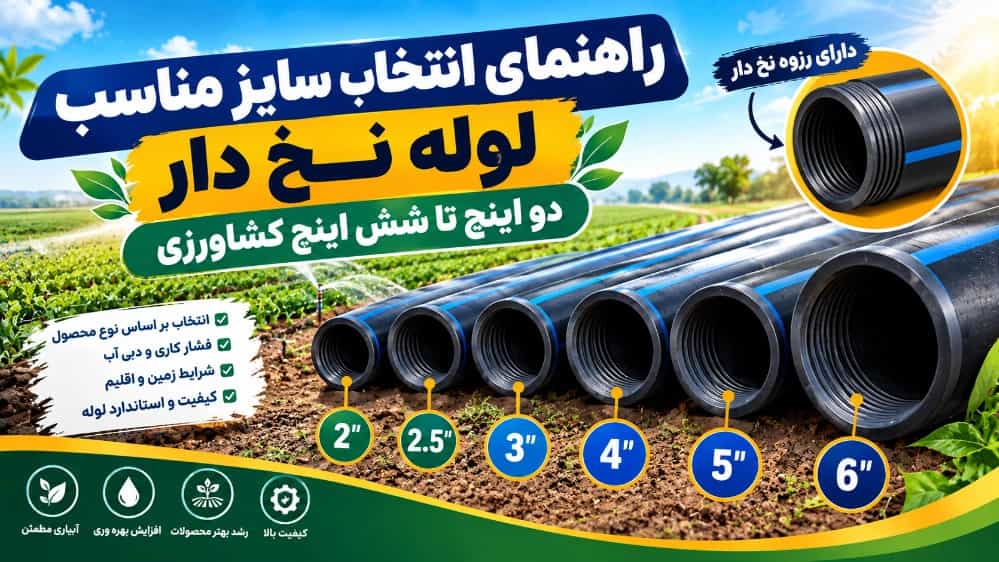
The management of water resources and the design of modern water supply networks require the use of standard and durable equipment. Agricultural threaded pipe has found a special place in Iran's farms and gardens as a flexible, light and economic alternative to rigid polyethylene and metal pipes. One of the main challenges faced by farmers in setting up these systems is choosing the size of the threaded pipe according to the irrigation volume and system pressure. Incorrect choice of pipe diameter can lead to severe pressure drop, rupture of the transmission line or insufficient flow to the plants. Liza Pipe Industrial Group, as a specialized reference for the production of water supply equipment, based on engineering standards, has compiled this article to review the technical and executive dimensions of two-inch to six-inch threaded pipe sizing for farmers and irrigation project managers.
Knowing the exact physical structure of threaded pipe is very important. These pipes are made of PVC or flexible polyethylene along with woven dense polyester fibers. The presence of these fiber threads increases the tensile and annular resistance of the pipe and prevents it from blowing or bursting under certain working pressures. Agricultural threaded pipe is considered an unbeatable option for leased agricultural land and seasonal crops due to its easy assembly, light weight and ability to quickly connect drip joints. In the following, we will analyze the key parameters and technical specifications of each size completely so that you can choose the best threaded pipe size from the Lisa Pipe collection.
Technical factors affecting the choice of agricultural threaded pipe size
The selection of the geometric dimensions of the pipe in agricultural projects is based on hydraulic calculations. The input flow rate of the water source is the first and most important variable. The volume of water that comes out of the well, pool or pump per second or hour determines the allowable volume of flow in the pipe. If the threaded pipe size is chosen smaller than the output flow rate, the internal friction will increase and the flow pressure will be wasted. On the contrary, if a pipe with an excessively large diameter is used, the initial cost of purchasing transmission lines will increase without any technical justification.
The working pressure of the system and the power of the electric pump or diesel pump is the second determining factor. Threaded pipes usually operate at pressures between 1 and 4 bar. The frictional loss in long routes depends on the inner diameter of the pipe, and as the diameter increases, the frictional head loss decreases. Farmers who are looking for the lowest energy loss, by accurately calculating the transmission path and consulting with Lisa Pipe engineers, buy the most suitable agricultural threaded pipe.
The slope of the land and the height and elevation of the route also affect the hydraulic pressure of the pipeline. On steep downward slopes, static pressure is added and there is a need to control the flow rate. On uphill slopes, improperly sized threaded pipe can result in stalled flow or very low yields at the end of the field. The length of the laterals or the side lines as well as the distance between the bushes, the number of tip tapes or nozzles connected to the agricultural threaded pipe will also directly determine the final size of the mother pipe.
The type of thread, the quality of the warp and weft and the thickness of the polymer layer are effective in bearing the pressure of any size. A good quality threaded pipe should not undergo laminar fracture against minor twists. Lisa Pipe Company uses high-strength industrial threads in its production lines to ensure that the two-inch to six-inch agricultural threaded pipe has the highest resilience against impact pressure and ultraviolet radiation from the sun.
Technical specifications and application of agricultural two-inch threaded pipe
The two-inch threaded pipe with a nominal diameter of 50 mm is considered the smallest commonly used size in this category. This pipe has the lightest weight and it can be moved and rolled in the field at a very high speed by one worker easily. Two-inch threaded pipe is an ideal choice for small farms, local greenhouses, vegetable gardens and home greenhouses, as well as branch lines in larger irrigation networks.
The standard output flow capacity for two inch threaded pipe is usually in the range of 3 to 6 liters per second. If the output flow rate of your pump is less than 15 cubic meters per hour, using this size has a high economic and technical justification. This pipe is recommended for direct connection of short-distance tapes or for use as a connecting pipe in distances of less than 100 meters. The two-inch agricultural threaded pipe produced by Lisa Pipe has gained a lot of popularity among greenhouse producers due to its extraordinary flexibility and smooth connection.
The important point in using two-inch agricultural threaded pipe is to prevent water from moving at speeds of more than 2 meters per second. High-speed flows in small-diameter pipes create a strong pressure drop, which prevents the uniform distribution of water in the tip outlets. Therefore, if your source output is stronger, it is better to use the larger sizes as the main line and use the two-inch threaded pipe only in the secondary rows.
A detailed investigation of the efficiency of two and a half inch agricultural threaded pipe
Two and a half inch threaded pipe is equivalent to a nominal diameter of 63 mm and is considered a bridge between light sizes and medium flow pipes. This size is chosen when the two-inch pipe does not provide enough flow to feed all the irrigation lines, and on the other hand, the use of the three-inch pipe is not necessary due to budget limitations or the lack of a high irrigation volume. The suitable flow for this size is defined in the range of 6 to 12 liters per second.
Farmers active in watermelon, tomato, cucumber and melon cultivation commonly use two and a half inch threaded pipe for fields of 1 to 3 hectares. The resistance of this pipe against environmental stresses and tension during spreading in the soil is evaluated as excellent. Liza Pipe Company, with the precise design of the web and weft in the two and a half inch threaded pipe, prevents the change of diameter or the local increase of the volume under the nominal pressure and ensures its durability during several agricultural seasons.
The connection of branch valves, fasteners and special connectors in 63 mm size can be done easily. The punching of the agricultural threaded pipe in these dimensions is done with minimal leakage due to having a favorable surface area. If your well's flow rate is moderate and the terrain is gently sloping, two-and-a-half-inch threaded agricultural pipe provides an ideal hydraulic balance for your water distribution network.
Performance and characteristics of agricultural three-inch threaded pipe
The three-inch size with a nominal diameter of 75 mm is one of the best-selling and most common options in the Iranian water supply market. Three-inch agricultural threaded pipe is typically used as a main pipe on 3-5 acre farms or as an auxiliary line on larger farm plots. This size can direct a flow rate of 10 to 20 liters per second with minimal internal friction.
One of the key advantages of three-inch threaded pipe is its universal compatibility with a variety of threaded fittings, nuts and quick-disconnect valves. In fields where tape drip irrigation has been implemented, the three-inch threaded pipe can feed dozens of tape lines at the same time without significant pressure drop in the end lines. Lisa Pipe experts recommend this pipe to farmers who intend to experience uniform and high-quality irrigation with a central branch.
The tensile strength of the three-inch threaded pipe of Lisa Pipe is very impressive in the face of momentary pressures resulting from the sudden start or shutdown of the pump. The woven fibers in the structure of this tube prevent local swelling, and its sun-proof PVC shell prevents it from becoming too soft against the scorching summer rays and heat. The three-inch threaded agricultural pipe is the first choice of many farmers in the country due to its economic justification and high compatibility with the flow rates of deep and semi-deep wells.
Practical advantages of agricultural four-inch threaded pipe
The four-inch threaded pipe, which is equivalent to the diameter of 90 and 100 mm, is considered a powerful transmission pipeline for high flow rates. When the cultivation area exceeds 5 hectares or the farmer needs to deliver the volume of water from the deep well, which is about 20 to 35 liters per second, to the distant parts of the land without wasting time, the four-inch threaded pipe enters the field.
This size of agricultural threaded pipe shows very little resistance to fluid flow due to its wider inner diameter. In this way, the energy produced by the pump is used to maintain the required pressure at the end of the line instead of overcoming the friction of the pipe. The four-inch threaded pipe of the Lisa Pipe brand is reinforced with the highest density of polyester fibers to show perfect performance in high-volume water transfer projects.
Four-inch threaded pipe can be used as the main transmission line from the head of the pool or well to the beginning of each piece of land, and then, using standard conversions, divide the water into three-inch or two-inch pipes. The weight of the four-inch threaded agricultural pipe, despite its very high strength, is such that compared to hard polyethylene pipes, storage costs, transportation and installation time are reduced by more than seventy percent.
Heavy duty agricultural five inch threaded pipe
The five-inch size with a nominal diameter of 125 mm is produced for heavy water supply, river and high-capacity pumping stations. The flow rate that can pass through the five-inch threaded pipe is between 35 and 55 liters per second. This high volume of flow requires a strong wall and an impermeable texture to withstand the battering rams and strong turbulence of the water coming out of the giant pumps.
Multi-ten acre grain, corn, sugar beet, and alfalfa fields that harvest water using strip or traditional high-volume methods are consistent customers for five-inch threaded pipe. This threaded agricultural pipe acts as a powerful manifold that can direct hundreds of liters of water per minute among different parts of the farm without a flow drop. In the production of this pipe, Lisa Pipe has increased the thickness of the wear-resistant layers so that the movement of the pipe on uneven, stony and rough ground is possible without causing damage to the inner layer.
Although each coil weighs five inches more than the smaller sizes, its flexibility and ability to collect after the harvest season greatly reduces the workload and labor costs of any metal pipe or carrogate. The five-inch agricultural threaded pipe produced by Lisa Pipe guarantees the transfer of huge amounts of water with a high reliability factor.
Six-inch agricultural and water supply threaded pipe with extraordinary capacity
The six-inch threaded pipe with a nominal diameter of 150 to 160 mm is the largest and strongest size in the category of flexible threaded pipes for agricultural uses. This pipe is suitable for passing flow rates of more than 50 to 90 liters per second and is generally used in large-scale water transfer systems, agricultural land consolidation plans and flood drainage.
At six-inch flows, the dynamic forces of water increase greatly. The slightest defect in the weave of the fibers or poor adhesion between the layers of the pipe can cause the line to split. Using advanced production lines and strict quality control, Lisa Pipe Company produces six-inch threaded pipe with the highest pressure tolerance standards so that farmers do not have to worry about the line breaking under heavy hydraulic loads.
The six-inch threaded agricultural pipe acts as a vital artery that pumps water from the source to several kilometers of storage ponds or a network of three- and four-inch subsidiary pipes. The use of this size of threaded pipe prevents large expenses for underground piping and channel digging, and after the end of the annual operation, it will be quickly collected and stored for the next season's cultivation.
Step-by-step guide for calculating and choosing the size of threaded pipe
In order for the farmer to be able to prepare the best size of agricultural threaded pipe, it is necessary to follow a logical and step-by-step process. First, the exact flow rate of the water source should be determined in terms of liters per second or pump inches. It is not always a requirement that the size of the pump outlet is equal to the size of the pipe, but choosing a pipe with a smaller diameter than the pump outlet seriously damages the hydraulic equipment and increases the consumption of electricity or diesel.
In the next step, water transfer distance and friction loss are calculated. If the distance from the well to the farm is long, Lisa Pipe designers always recommend using a larger farm threaded pipe size to compensate for the pressure drop along the way. For example, if the flow rate of the pump is compatible with a three-inch pipe, but the length of the transmission line is more than five hundred meters, using a four-inch threaded pipe will help reduce the final pressure drop.
The third step is to evaluate the method of branching in the field. If the threaded pipe is to be connected directly to the tapes, the number of connections and the volume of water required for all rows should be calculated. For modern drip farms, the combination of agricultural threaded pipe in various sizes is the best method; به این صورت که لوله چهار یا پنج اینچ نقش خط انتقال اصلی را بازی میکند و لولههای سه یا دو اینچ به عنوان مانیفولدهای توزیع در میان قطعات به کار گرفته میشوند.
The fourth step is to consider the type of soil and the type of product. Some crops require a concentrated and heavy volume of water in a short time in certain growth periods, which requires a pipe with a higher flow rate. The sales experts of Lisa Pipe, by examining the geographical conditions and the actual irrigation needs of your land, offer the most economical and efficient size of threaded pipe in a completely specialized way.
The advantages of Lisa Pipe threaded pipe compared to other water transfer methods
Agricultural threaded pipe manufactured by Lisa Pipe is designed and produced based on the use of high-quality PVC granules and continuous polyester fibers. These pipes are resistant to the ultraviolet rays of the sun and do not suffer from dryness, scaling and cracking caused by the burning sun. The special additives used in Lisa Pipe products give the pipe great flexibility even in the coldest days of the year.
The significant reduction of costs is another very important factor. Lisa Pipe's two-inch to six-inch agricultural threaded pipe is priced very competitively with rigid polyethylene pipe and metal pipe. The speed of opening and closing and rolling of these pipes increases the labor efficiency and makes the damage caused by successive moving close to zero. From the fields of the central plains to the rugged terrains of the foothills, Lisa Pipe threaded pipe brings reliability, productivity and durability.
Principles of maintaining and increasing the life of agricultural threaded pipe
In order to achieve maximum efficiency and continuity of efficiency of the threaded pipe in many seasons, it is necessary to observe some executive points. At the time of laying the agricultural threaded pipe on the ground, the road bed should be cleared of sharp stones, metal debris and thick roots to prevent surface cuts of the pipe. Although the fiber layers of Lisa Pipe have high resistance, the reduction of mechanical stresses extends the useful life of the product by several years.
Regulating the water pressure and preventing the pressure from increasing above the permissible limit is very important. The use of air discharge valves and pressure breakers in long routes prevents ram impact and damage to the agricultural threaded pipe. At the time of closing the pump, the water should be drained slowly so that a sudden vacuum does not cause the inner walls of the pipe to stick to each other.
After harvesting the product, the threaded tube should be washed thoroughly and its internal sediments removed. Pipes should be rolled dry and regularly and stored in roofed warehouses, away from long-term sunlight and access to rodents. These simple maintenance measures will insure the health of the thread and polymer structure of your agricultural threaded pipe for many years.
summary
Determining the size of two-inch to six-inch agricultural threaded pipe is a fundamental step in building basic and low-cost water supply systems. The two- and two-and-a-half-inch sizes are great for confined areas and sidelines, the three-inch threaded pipe provides the perfect balance for medium-sized fields, and the four-, five-, and six-inch sizes cover the heavy-duty needs of high-flow conveyance and extensive fields. Choosing the wrong pipe size not only reduces irrigation efficiency, but also damages the pump and farm facilities. Liza Pipe Industrial Complex, by producing and supplying a full range of agricultural threaded pipes with the highest durability and quality standards, is always with the hardworking Iranian farmers to achieve the highest productivity from every drop of water by using standard equipment.